Metro Safety Training Team
Certified Instructor & Editorial Team
Updated November 18, 2026
A first aid certificate shows that a worker can treat an injury. It does not show that the worker can safely move an injured colleague to a hospital or clinic. For crews far from town or crews that travel between sites, that gap is what the transportation endorsement fills.
This page explains who needs the endorsement, what WorkSafeBC requires, what the course covers, and how Metro Safety Training sequences it with an Occupational First Aid (OFA) course in Metro Vancouver.
What a transportation endorsement adds to first aid training in BC
A transportation endorsement is a WorkSafeBC add-on. It trains a first aid provider to transport an injured worker to medical aid. Employers and learners often search for it as the OFA transportation endorsement in BC.
It is not a first aid certificate on its own. The endorsement is held on top of a valid base certificate, never in place of one. A worker with an expired base certificate has no endorsement to rely on.
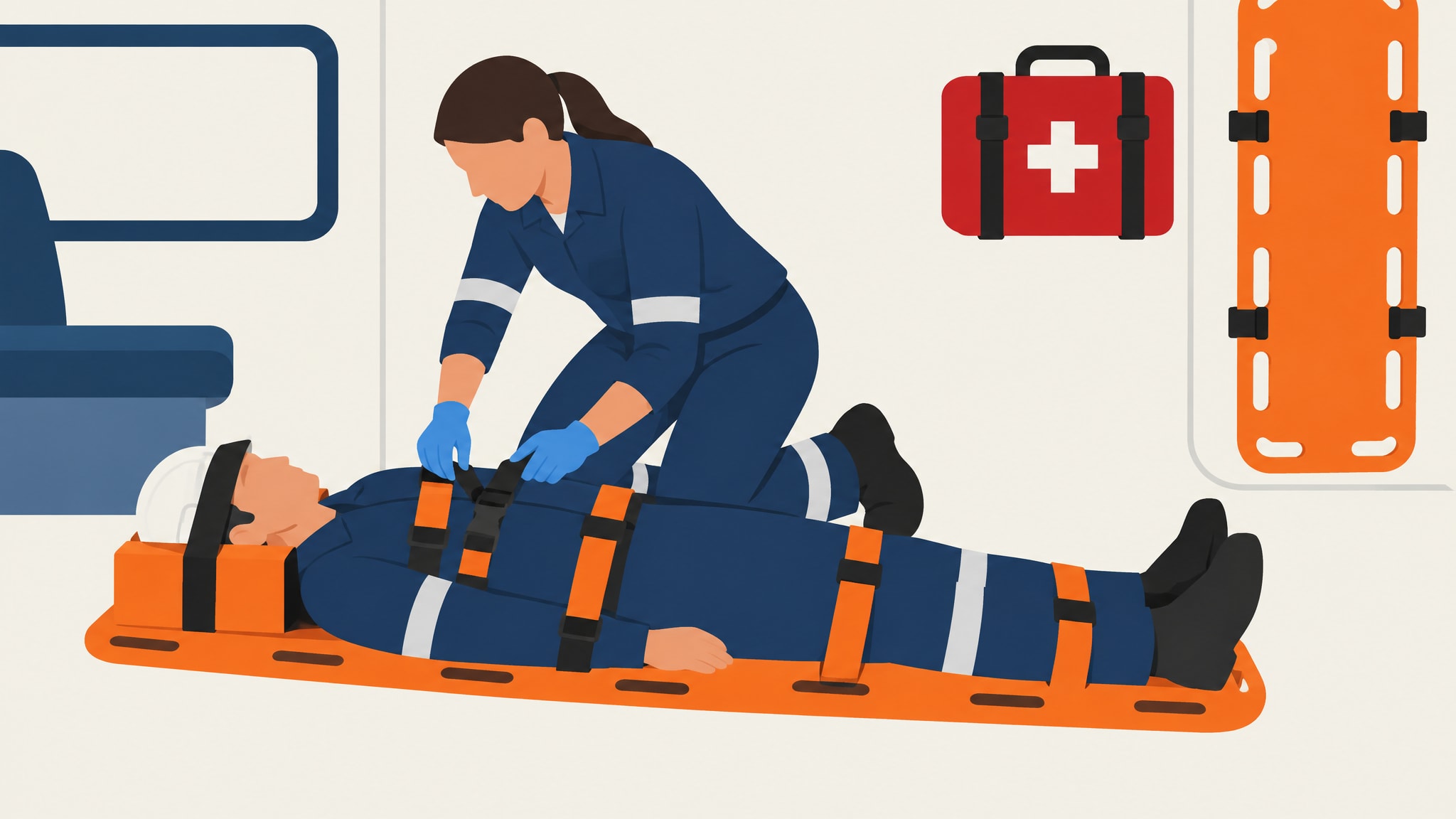
The endorsement exists because treating a worker and moving a worker are separate skills. Moving someone with a spinal, chest or abdominal injury can make the injury worse. The course teaches the attendant to decide whether to move the worker at all.
The endorsement does not make a first aid attendant a paramedic. It also does not replace calling for an ambulance when one can reach the site in reasonable time.
Who needs a transportation endorsement on remote and mobile crews
The endorsement matters when a first aid provider may have to move an injured worker to medical care because an ambulance is slow or unavailable. The attendant's role decides the need, not the industry label on the business.
WorkSafeBC sets the requirement, and each employer has to check its own sites against it. Employers who are still working out the base level can start with which first aid level your workplace needs. The WorkSafeBC first aid attendant requirements by workplace page covers the attendant rules for each workplace type.
Remote worksite first aid in BC: when ambulance response is slow
Consider a field crew working far from town on a resource road. An ambulance could take a long time to arrive, so the crew's first aid attendant may be the person who has to move an injured worker toward care. That attendant needs training in how and when to do it.
An employer with a remote worksite can run a short self-check:
- How far is the site from the nearest medical care, and how long does the trip take on the real access road?
- Can an ambulance reach the site reliably in all seasons and weather?
- If the ambulance is delayed, who on site would transport the worker, and are they trained to?
WorkSafeBC does not publish a single distance that applies to every site, so this article does not set one. If the answers point to slow or uncertain ambulance access, the employer should confirm with WorkSafeBC whether the endorsement applies. That is the safer route than assuming it does not.
First aid for mobile crews in BC: when the crew travels between sites
A mobile crew works at temporary job sites through the week. The sites change, the road conditions change, and the distance to a hospital changes with them. A site that sits ten minutes from a hospital on Monday may be much farther away by Thursday.
The self-check for mobile crews looks at movement as well as distance:
- Does the crew work at sites where ambulance access is uncertain, even for part of the week?
- Does the first aid attendant travel with the crew, or is the attendant tied to one location?
- Would the crew's vehicle be the practical way to reach care if an ambulance could not?
Mobile crews have one more problem. Each rotation can bring a different attendant on shift, so the endorsement has to follow the crew from site to site, not stay with one person who happens to be elsewhere.
WorkSafeBC transportation endorsement requirements
WorkSafeBC sets the occupational first aid requirements in BC, including when the transportation endorsement applies. Employers should read the regulator's current published wording rather than rely on a provider's summary, because provider pages do not all list the same base certificates. Canadian Red Cross Emergency First Aid, for example, appears on some of them.
Metro Safety does not decide which certificates qualify. WorkSafeBC does, and the list can change, so the safest step before booking is to check the current wording.
Base first aid certificates needed before you book
A learner needs a current base first aid certificate that WorkSafeBC accepts for the endorsement. "Current" means unexpired on the day of the class, not merely held at some point.
Before booking, a learner should check three things:
- The name of the base certificate on the card or record.
- The expiry date on that record.
- Whether that certificate appears on WorkSafeBC's published list of qualifying certificates.
A learner who holds no base certificate yet cannot book the endorsement alone. The base course comes first, and the endorsement follows it.
Keeping the endorsement current with your first aid certificate
The endorsement sits on a base certificate. Its renewal should therefore be tracked alongside that certificate's expiry date, with both dates in one record.
A base certificate that lapses leaves the endorsement without anything to sit on. Employers should not assume the two run on separate calendars. For the period a certificate stays valid, see how long BC first aid certification stays valid. For timing, see the renewal deadlines for BC first aid certificates.
Safety officers managing several attendants usually do best with one list showing each person's base certificate, expiry date and endorsement status.
What the transportation endorsement course covers
The course centres on one task: getting an injured worker to medical aid. It follows WorkSafeBC's outline and stays on that task. Four areas make up the content:
- Scene and patient assessment. The attendant checks the scene for hazards and assesses the worker's condition before any decision about moving.
- Whether to move the worker. Some injuries mean the worker should stay where they are, so the course teaches the attendant to make that call.
- How to move the worker. When moving is the right choice, the attendant learns how to do it and how to transport the worker safely.
- Handover and documentation. The attendant hands the worker over to medical care and records what happened.
The course does not teach general first aid treatment again. It assumes the learner already holds a base certificate.
Class length comes from Metro Safety's class schedule, so check the schedule entry for the session you plan to attend. Employers building a crew timetable need that figure before they release staff for the day.
How Metro Safety bundles the transportation endorsement with OFA courses
Metro Safety Training provides WorkSafeBC-certified first aid and CPR training in Coquitlam, Vancouver, Burnaby, Richmond and Surrey. That gives Lower Mainland employers a local booking option, so crews do not need to travel far for the course.
The endorsement is sequenced with an OFA course. The base certificate comes first and the endorsement follows it.
Taking the endorsement alongside an OFA course
OFA courses come in three levels, and they differ in scope. Level 1 is the entry level and suits lower-risk workplaces. Level 2 covers more, and Level 3 is the most advanced. WorkSafeBC assigns a workplace its required level through the first aid assessment, which weighs the hazard rating, the number of workers and the travel time to medical care.
That assessment is also where remote and mobile crews usually first see the endorsement come up. A site that sits far from medical care tends to need both a higher base level and the transport training.
Metro Safety confirms the pairing before a learner books:
- The learner's current base certificate and OFA level.
- Whether the endorsement follows that level on the class schedule.
- How to sequence the two so the base certificate is valid on the endorsement date.
For learners who still need the OFA course itself, there is more on OFA course dates and booking in the Lower Mainland.
Transportation endorsement course in the Lower Mainland
For a transportation endorsement course in the Lower Mainland, Metro Safety's training locations are Coquitlam, Vancouver, Burnaby, Richmond and Surrey. Not every location necessarily runs every class on every date.
The class schedule shows which city hosts the endorsement session on which day. A crew based in Surrey and working out of Richmond can pick whichever location suits its shift pattern. Employers with crews in several cities should ask which sessions are closest to each work base.
What to confirm before you book a transportation endorsement course
A booking made on a wrong assumption costs a crew member a day and may leave the employer without a valid endorsement. Four checks prevent that:
- The prerequisite certificate. Confirm which base certificate the course requires and that the learner's certificate matches it and is unexpired.
- WorkSafeBC approval. Confirm the course is WorkSafeBC-approved. A course without approval will not satisfy the requirement.
- Format and location. Confirm whether the class is held in person, and in which city, before releasing a worker for the day.
- The completion record. Ask what the record shows. An employer needs it for the files, so check that it names the learner, the endorsement and the date of completion.
Employers comparing several providers can use how to choose a first aid training provider in BC for a wider set of criteria.
This checklist covers the booking only. It does not tell an employer whether the workplace needs the endorsement in the first place. That answer comes from WorkSafeBC's requirements and the employer's own first aid assessment.
Planning endorsement cover across crew shifts
One endorsed attendant does not cover a workplace that runs more than one shift. When the endorsed person is off, the crew has no one trained to transport an injured worker.
Take a mobile crew that moves between temporary job sites during the week. Its on-shift attendant changes with each rotation, so cover has to follow the crew on every move. A schedule that endorses one attendant on the Monday shift leaves Thursday uncovered.
Three planning points help:
- List every shift and rotation, and name the endorsed attendant for each one.
- Allow for turnover. When an attendant leaves, the endorsement leaves with them.
- Track base certificate expiry dates, since a lapsed base certificate takes the endorsement with it.
WorkSafeBC may set a minimum number of attendants for a given workplace. Employers should confirm any minimum headcount with WorkSafeBC and not assume one.
Group bookings for a whole crew
Training several attendants at once makes scheduling easier, because one class date covers the whole crew. Employers looking at the cost can read about group first aid training rates for companies.
Employers and safety officers can contact Metro Safety Training with three details: the crew's size and base certificates, their OFA level, and their work locations. The team will confirm the endorsement sequence and the nearest Lower Mainland class before anyone books.
Frequently asked questions
What is the difference between Level 1, 2 and 3 first aid in BC?
The three OFA levels differ in scope. Level 1 is the entry level for lower-risk workplaces, Level 2 covers more, and Level 3 is the most advanced. WorkSafeBC assigns the required level through the workplace's first aid assessment, which looks at hazard rating, worker numbers and travel time to medical care.
Can I take the transportation endorsement without a first aid certificate?
No. The endorsement is held on top of a valid base certificate, not in place of one. A learner needs a current certificate that WorkSafeBC accepts for the endorsement before booking.
How long is the transportation endorsement course?
Metro Safety's class schedule gives the length for each session, so check the entry for the class you plan to attend. Employers planning crew timetables should confirm the figure before releasing staff. The course covers scene and patient assessment, whether and how to move the worker, handover and documentation.
What are the options for medical transportation of an injured worker in BC?
The usual route is an ambulance. When an ambulance is slow or unavailable, as on some remote and mobile sites, a trained first aid attendant may have to move the worker to medical care. The transportation endorsement prepares the attendant for that decision and for the handover.
Need Safety Training?
Metro Safety Training runs WorkSafeBC-recognized first aid, CPR and workplace safety courses in Coquitlam, Surrey and Burnaby, and on-site anywhere in Metro Vancouver.
coquitlam
surrey