Metro Safety Training Team
Certified Instructor & Editorial Team
Updated August 11, 2026
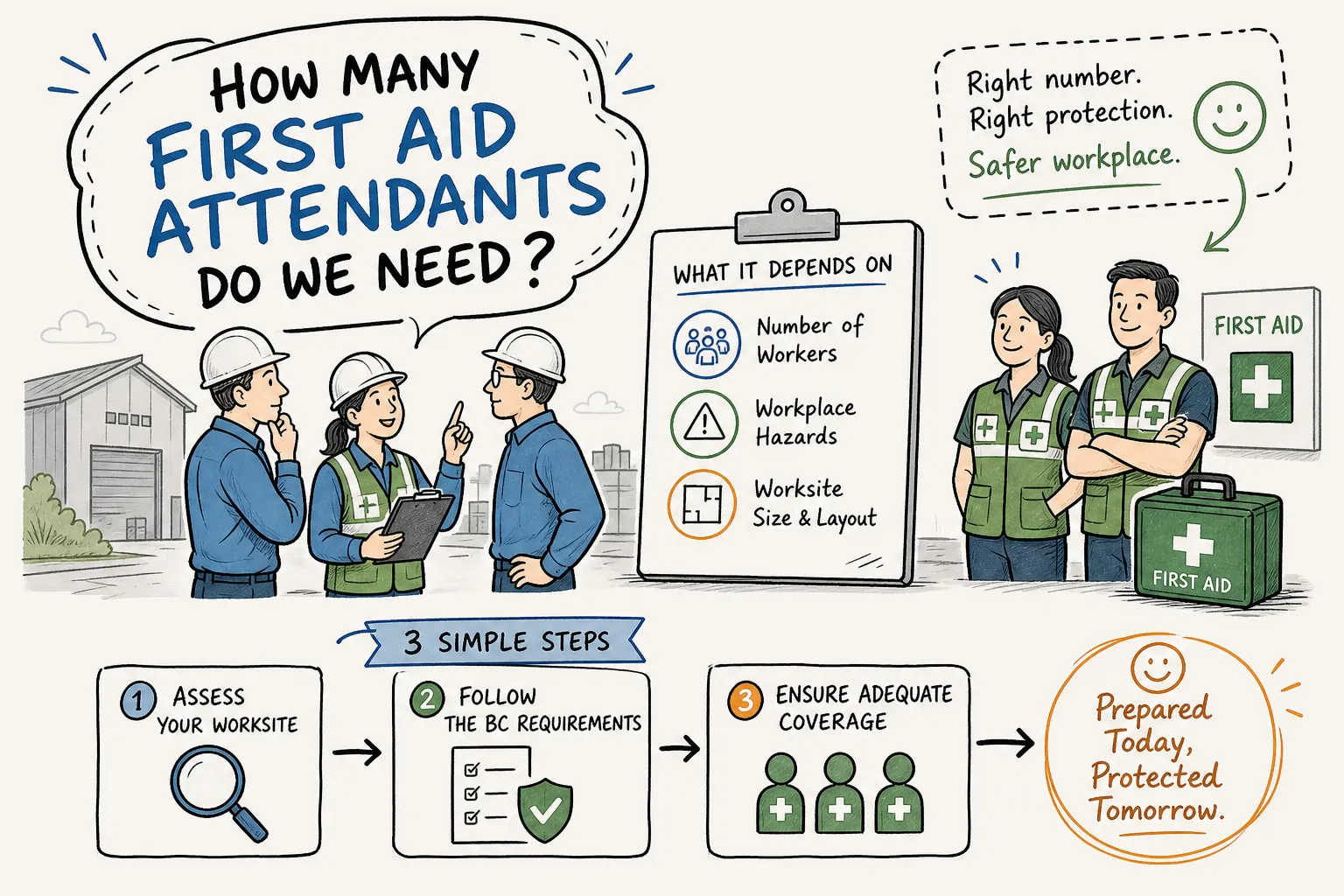
Determining how many first aid attendants does a bc worksite need is a vital compliance step for every employer. In British Columbia, the requirement isn't just one fixed number. Instead, you must calculate your needs based on your workplace class, hazard rating, and the maximum number of workers on a single shift.
- Requirements depend on Workplace Class (location), Hazard Rating, and Worker Count.
- Class 1 sites are urban areas where an ambulance can arrive within 30 minutes.
- Hazard ratings range from Low (offices) to High (construction).
- You must have a certified attendant physically present during all hours of operation.
- Training levels include Basic (OFA 1), Intermediate (OFA 2), and Advanced (OFA 3).
- Certification: WorkSafeBC Occupational First Aid (OFA)
- Validity: 3 Years
- Locations: Burnaby, Coquitlam, Surrey, or On-site
- Audience: BC Employers, Managers, and Safety Officers
- Registration: Online via Metro Safety Training
Check Course Availability & Register Now
Table of Contents
- Step 1: Classifying Your Worksite
- Step 2: Calculating Numbers via Schedule 3-A
- Real-World Examples
- Shift Coverage and Equipment
- Getting Your Team Certified
Step 1: Classifying Your Worksite
Occupational First Aid (OFA) requirements start with two factors. These determine which specific table in the regulations applies to your business.
The Four Workplace Classes
Workplace class depends on geography and emergency access. Class 1 is the standard for most urban areas. This means a BC Emergency Health Services ambulance can reach your site within 30 minutes. If you operate in developed areas like Coquitlam, Vancouver, or Burnaby, you are likely Class 1. Class 2, 3, and 4 designations apply to remote areas where ambulance response takes longer.
Low, Moderate, and High Hazard Ratings
Your hazard rating is tied to your WorkSafeBC classification unit (CU). Typical examples include:
- Low Hazard: Professional offices, retail stores, and libraries.
- Moderate Hazard: Light manufacturing, distribution centers, and warehouses.
- High Hazard: Construction sites, logging, and heavy industrial facilities.
Step 2: Calculating Attendant Numbers via Schedule 3-A
Once you know your class and hazard, check your worker count. For a Class 1 workplace, the requirements scale quickly. For example, a moderate-hazard site with 19 workers needs one Basic attendant. If you hit 20 workers, the requirement jumps to an Intermediate attendant and a dedicated dressing station.
Understanding this Occupational First Aid (OFA) guideline is vital. A small change in staff numbers can shift your compliance needs. If you have 20–49 workers in a high-hazard environment, you must provide an Intermediate attendant and an Intermediate kit.
Understanding Training Levels
WorkSafeBC recognizes three levels of training:
- Basic Attendant: Holds a Basic First Aid (OFA 1) certificate (1-day course).
- Intermediate Attendant: Holds an Intermediate First Aid (OFA 2) certificate (2-day course).
- Advanced Attendant: Holds an Advanced First Aid (OFA 3) certificate (10-day course).
Real-World Examples: BC Workplaces Side-by-Side
Here is how these rules look for typical businesses in the Lower Mainland:
| Workplace Type | Hazard Level | Workers | Requirement |
|---|---|---|---|
| Burnaby Office | Low | 30 | Basic Kit + Basic (OFA 1) Attendant |
| Richmond Construction | High | 40 | Intermediate Kit + Intermediate (OFA 2) Attendant |
| Surrey Warehouse | Moderate | 110 | Intermediate Kit + Intermediate (OFA 2) Attendant |
Failing to meet these levels leads to inadequate first aid provision, which puts workers at risk and invites fines.
Shift Coverage and Equipment Essentials
WorkSafeBC rules apply to each shift separately. If your day shift has 80 workers but your night shift has only 10, your requirements will differ for each period. You must ensure a certified attendant is physically present during all working hours.
Additionally, your equipment must match your attendant's level. For example, you cannot have an Advanced attendant on site with only a basic kit. Proper first aid kit maintenance is just as important as the training itself. For high-risk sites, equipment may include oxygen therapy and airway management tools.
Getting Your Team Certified in Metro Vancouver
Many employers find it hard to coordinate training without stopping work. Metro Safety Training offers flexible options at our campuses in Coquitlam, Burnaby, and Surrey. We can even provide on-site training for large groups. This ensures your team gets First Aid Training in Coquitlam or surrounding cities efficiently.
Frequently Asked Questions
How do I know if I am Class 1 or Class 2?
It depends on the travel time for an ambulance. If the BC Emergency Health Services can reach your site in under 30 minutes, you are Class 1.
Do I need a first aid room?
This depends on your hazard rating and worker count. High-hazard sites with more than 50 workers or moderate-hazard sites with more than 100 workers usually require a first aid room.
Does my certificate expire?
Yes. WorkSafeBC certificates are valid for three years. You should plan for Advanced First Aid Renewal or Basic recertification before your current card expires.
Conclusion: Meeting the Safety Floor
The calculation is simple: Class + Hazard + Worker Count = Your Requirement. By documenting your assessment and keeping certifications current, you protect your business and your staff. Don't wait for a WorkSafeBC compliance inspection to find a gap. Start your assessment today.
Ensure your worksite stays compliant. Register for your next WorkSafeBC-approved first aid course at one of our Lower Mainland locations today.
Frequently Asked Questions
Need Safety Training?
Metro Safety Training runs WorkSafeBC-recognized first aid, CPR and workplace safety courses in Coquitlam, Surrey and Burnaby, and on-site anywhere in Metro Vancouver.
coquitlam
surrey