Metro Safety Training Team
Certified Instructor & Editorial Team
Updated November 16, 2026
Warehouses and distribution centres employ a large share of the workforce in Surrey and Richmond. They also share a set of injury risks that office and retail sites do not. A first aid course for warehouse workers in BC is the standard WorkSafeBC-certified occupational first aid training, applied to a warehouse floor.
Metro Safety Training delivers WorkSafeBC-certified First Aid and CPR courses in Coquitlam, Vancouver, Burnaby, Richmond and Surrey, so Lower Mainland warehouse teams can train close to their sites. This guide covers the hazards, how to confirm the right level, and how to fit training around shift work.
Why Warehouses Need Trained First Aid Attendants
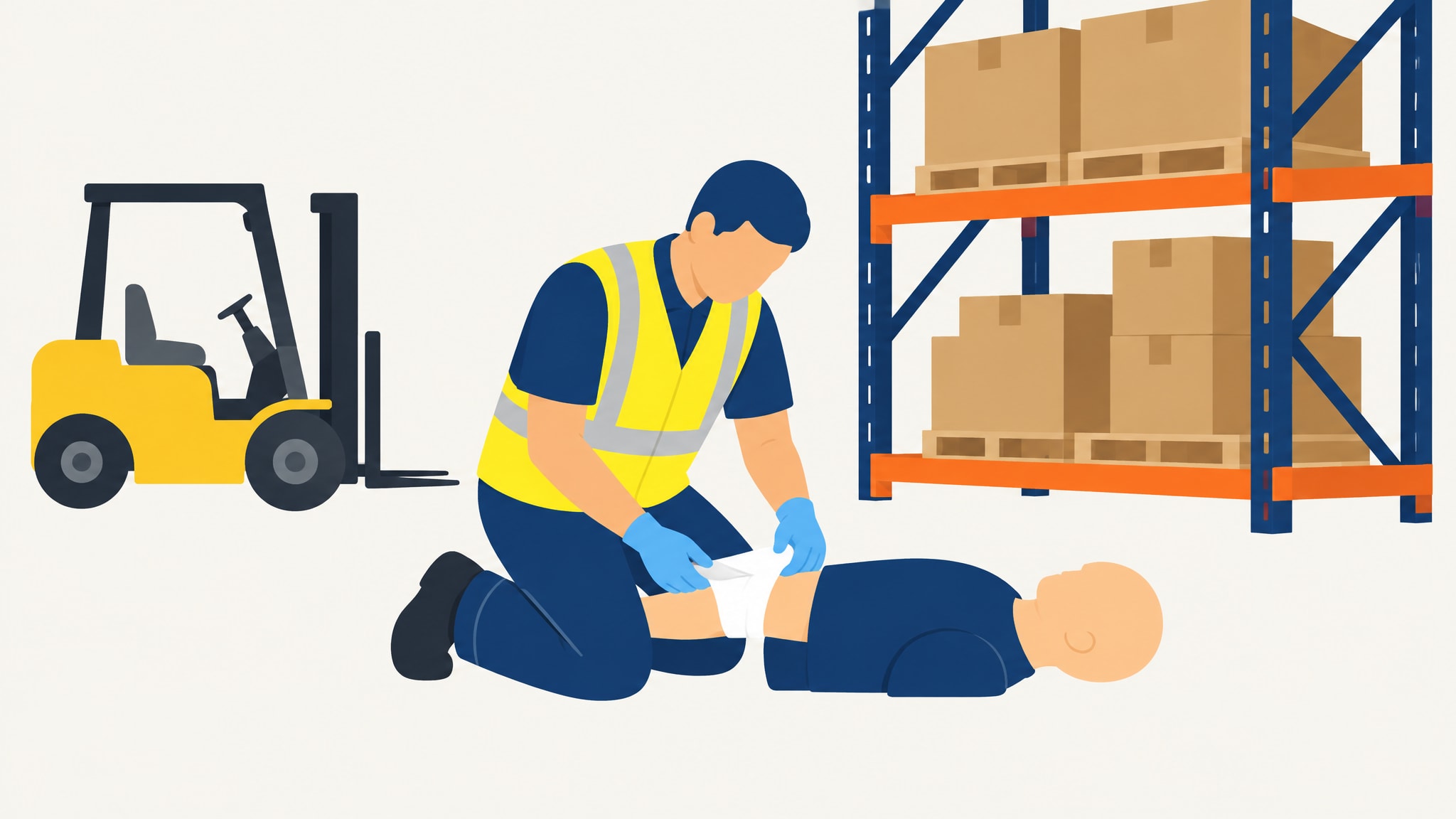
A warehouse puts forklifts, pallet racking, manual handling and conveyor equipment on the same floor. Workers move between those zones all day, and an injury in one of them can happen fast and far from the office.
Shifts add a second problem. A site that has a certified attendant on the day shift may have nobody on nights or weekends, and a single absence can leave a whole shift uncovered. Warehouse worker safety training in BC therefore has to be planned around the roster, not just the headcount.
There is no separate "warehouse first aid certificate." The credential is a standard WorkSafeBC-certified occupational first aid course. What makes it relevant to a warehouse is the content of the practice scenarios and the employer's own hazard planning, such as where pinch points are, where chemicals are stored, and how an ambulance reaches the loading dock.
If you manage a site, that means you choose the course by level and provider, then bring the warehouse into it through the scenarios you ask the instructor to cover.
Warehouse Hazards That Shape First Aid Training
Most warehouse incidents are ordinary: a strained back, a cut hand, a slip near a dock door. A smaller number are severe. An attendant has to be ready for both, and the course content should match that spread.
Forklift Incidents and First Aid Requirements in BC
Forklift operator training and first aid attendant training are separate requirements. A forklift training record does not count as first aid coverage, and a first aid certificate does not qualify anyone to operate a forklift. Employers need to satisfy each one on its own.
A forklift operator who also holds a first aid ticket is useful, but that person cannot treat an injury while driving the truck. Coverage has to be planned for the moment a forklift incident actually happens.
Attendants at a site with powered industrial trucks should be ready for several injury types:
- Struck-by and pinning injuries. These involve a worker hit by a truck or trapped between a truck and a rack, dock edge or trailer. The attendant assesses the person, controls bleeding and calls for emergency transport.
- Crush injuries from loads. A pallet that tips or a load that drops can crush a limb or the torso. These are serious, and the attendant's job is early recognition, monitoring and a fast call for help.
- Acid or electrolyte exposure. Forklift battery charging areas can expose workers to battery acid. The attendant needs to recognize chemical contact with skin or eyes and follow the site's rinsing and emergency procedures.
Whichever one it is, the attendant's role is to assess, stabilize and hand over to paramedics.
Heavy Lifting, Slips, and Repetitive Strain Injuries
The dramatic incidents get the attention, but strains and sprains are the everyday cases. Lifting, twisting and reaching for stock produce them constantly, and an attendant who can assess them properly keeps a minor injury from becoming a lost-time claim.
Slips matter just as much. Wet floors near dock doors and loose stretch wrap on the ground are classic causes, and they lead to sprains, fractures and head injuries. Lacerations from box cutters and strapping round out the common list.
Each of these maps to what an occupational first aid course teaches:
- Assessment to decide whether a worker can keep working, needs a doctor, or needs an ambulance.
- Wound care for cuts from blades, strapping and splintered pallets.
- Splinting for suspected sprains and fractures until the worker can be transported.
- Knowing when to call emergency transport, including for head injuries, suspected spinal injuries and heavy bleeding.
First aid does not treat repetitive strain over weeks or months. It covers the acute injury in front of the attendant, and long-term strain prevention belongs to your ergonomic and manual handling program.
Occupational First Aid for Logistics Sites: Choosing the Right OFA Level
The entry course is Occupational First Aid Level 1, usually shortened to OFA 1. Higher levels exist, and picking between them depends on rules your workplace has to confirm for itself.
What Sets the Required Level and Attendant Count
WorkSafeBC's first aid requirements sit in the OHS Regulation. The required level and the number of attendants depend on the workplace's hazard classification and the number of workers. An employer should confirm its own classification instead of assuming a level, because a neighbouring warehouse may be classified differently.
If you are not sure where your site lands, read how to work out which first aid level your workplace needs. The WorkSafeBC attendant level requirements by workplace page lists the details in more depth.
Coverage has to hold on every shift, including nights and weekends. A practical plan puts at least one qualified attendant on each shift, plus trained backups, so that sick days, vacations and turnover do not leave a gap. The exact number your site needs comes from the regulation and your classification, not from a rule of thumb.
OFA Level 1 Compared With Levels 2 and 3
OFA 1 is the entry occupational course. Levels 2 and 3 build on it with more depth in patient assessment and serious injury care, and they suit larger or higher-hazard workplaces where attendants may manage an injured worker for longer before paramedics arrive.
A warehouse with forklifts and heavy loads should confirm its classification before choosing a shorter emergency-level course. It should also confirm before assuming Level 3 is necessary. Booking too low risks non-compliance, while booking too high spends time and money on training the regulation does not ask for.
This comparison does not tell you which level your site needs. Only your classification and headcount can do that.
Choosing a First Aid Course for Warehouse Workers in BC
Once the level is settled, the choice comes down to price, format and dates. Provider status matters as well, and how to choose a first aid training provider in BC covers how to check that a course is WorkSafeBC-certified before you pay.
Cost, Group Pricing, and Free Options
Course price moves with four things: the level, the length of the course, the class size and whether you book as a group. OFA 2 and 3 take longer than OFA 1, so they cost more. A team booking several attendants at once can usually get a better per-person arrangement than individual bookings. For employers sending several people, group first aid training rates for companies explains how that works.
Free first aid sessions do exist. They are usually awareness talks or short demonstrations rather than certificate courses. A free session generally does not meet WorkSafeBC requirements, so do not count its attendees as your designated attendants unless the course is explicitly WorkSafeBC-certified at the right level.
Public Class Dates Around Rotating Shifts
OFA courses include hands-on practice such as bandaging, splinting and patient assessment, and that practice needs in-person attendance. A purely online option will not replace it.
That makes the roster the main scheduling constraint. Public classes run across the Coquitlam, Vancouver, Burnaby, Richmond and Surrey locations, so you can pick a date and a site that suit each person's shifts. Staff on nights can often attend a daytime class after finishing a rotation, and a supervisor can stagger attendance so the floor never loses all its trained people at once.
Before booking, confirm the course is WorkSafeBC-certified and that the level matches your requirement.
Industrial First Aid Training Across the Lower Mainland
Metro Safety Training runs courses at five locations in Metro Vancouver: Coquitlam, Vancouver, Burnaby, Richmond and Surrey. Warehouse and distribution employers cluster in Surrey and Richmond, so having a class nearby means shorter travel and less time off the floor. Industrial first aid training in the Lower Mainland works best when the course is close enough that staff can attend before or after a shift.
Surrey and Richmond Warehouse Employers
If your site is in the Surrey or Richmond corridor, both of those locations are available. Employers choosing between Surrey and Vancouver can compare them at Surrey or Vancouver: which location suits your team.
Keeping Warehouse First Aid Attendants Certified
Certification is not a one-time task. You need to keep a current certificate on file for each designated attendant, track every expiry date and book recertification before a card lapses. An attendant with an expired certificate no longer counts toward your required coverage.
Renewal Dates and Expiry Tracking
How long a certificate lasts depends on the course and the certifying body. Check the expiry date printed on each certificate instead of relying on memory or a general rule. For the full picture, see how long first aid certification stays valid in BC.
A simple spreadsheet works: attendant name, shift, course level, expiry date. Add a reminder well ahead of each expiry so there is time to book a class that fits the roster. If two attendants on the same shift expire in the same month, stagger their renewals so the shift keeps coverage.
Booking an OFA Course for Your Warehouse Team
Start by confirming your OFA level and the number of attendants your classification and headcount require, including backups for every shift. Then choose a public class date at the nearest location that fits your shift roster. Finally, book the seats, or request a group quote if you are training several people together.
If you have already confirmed Level 2 as your requirement, go straight to OFA Level 2 course dates and booking in the Lower Mainland.
Frequently asked questions
What is level 1 first aid called in BC?
The entry occupational course is called Occupational First Aid Level 1, usually shortened to OFA 1. Levels 2 and 3 add depth in assessment and serious injury care. Which one your workplace needs depends on its hazard classification and number of workers.
How much does a first aid course for a workplace cost?
Price depends on the course level, the length of the course, the class size and whether you book as a group. Higher levels take longer and cost more than OFA 1. If you are training several attendants, request a group quote instead of booking seats one by one.
Is first aid certification valid for 2 or 3 years?
It depends on the course and the certifying body. Check the expiry date printed on your certificate, and book recertification before that date passes so the attendant stays on your coverage.
Is there any free first aid course that counts for work?
Free sessions are usually awareness talks, not certificate courses. They generally do not meet WorkSafeBC requirements for designated attendants. Confirm that a course is WorkSafeBC-certified at the right level before you count anyone toward your coverage.
Need Safety Training?
Metro Safety Training runs WorkSafeBC-recognized first aid, CPR and workplace safety courses in Coquitlam, Surrey and Burnaby, and on-site anywhere in Metro Vancouver.
coquitlam
surrey