Metro Safety Training Team
Certified Instructor & Editorial Team
Updated October 30, 2026
A first aid course for personal trainers in BC is usually a condition set by someone else: the gym that hires the trainer, the insurer behind the policy, or the body that issued the trainer's fitness credential. Metro Safety Training delivers WorkSafeBC-certified First Aid and CPR training in Coquitlam, Vancouver, Burnaby, Richmond and Surrey. This page explains where the requirement comes from, which course to book, what the training covers and how to keep it current.
The requirement is real, but a government licence is not its source.
Where the First Aid Requirement for Personal Trainers Comes From
Personal training is not a licensed occupation in BC, so no provincial licence asks for first aid. The requirement comes from the gym as employer, from an insurer, or from a certifying body, and a trainer without a current certificate may find it hard to start or keep a position.
Employer and Gym Policy Requirements
A gym is a workplace, and WorkSafeBC sets first aid obligations for workplaces. Those obligations depend on the size and risk of the workplace, so a large club with several floors and a small private studio will not have identical arrangements. Employers and safety officers can read through which first aid level a workplace needs in BC to see what applies to their site.
Trainers should ask the gym for its written first aid standard before enrolling in any course. Gyms word their policies differently, and a certificate that does not match the wording can mean paying for a second course.
Trainers who rent floor space as independent contractors are in a similar position. The requirement then tends to sit in the contract or the gym's house rules rather than in an employment file, and the same written standard answers the question.
Insurance and Certifying-Body Expectations
Some insurers and certifying bodies ask for proof of current first aid and CPR. Proof means the certificate itself, so a trainer keeps a copy where it can be produced when the insurer or the gym asks.
Trainers certified through a body such as CanFitPro should read that body's current published requirements directly. They change over time, and this page does not restate them. The same applies to any liability policy: the insurer's own wording decides what counts.
Choosing the Right First Aid Course for Personal Trainers
The first aid course for personal trainers in BC that this article is built around is standard first aid combined with CPR-C. A second course, Occupational First Aid Level 1, applies only in a narrower case.
Standard First Aid with CPR-C: The Combined Course
The combined course is a single booking. It includes AED use, so a trainer does not need a separate class to learn the defibrillator that hangs on most gym walls. CPR certification for personal trainers in BC comes as part of this booking, which keeps the paperwork to one course and one set of dates.
Course length and price change, so both should be taken from the provider's current listing rather than from a blog post.
This course does not replace Occupational First Aid Level 1. A gym that requires the longer WorkSafeBC course will not accept the combined course in its place.
When a Gym Asks for Occupational First Aid Level 1
Occupational First Aid Level 1 is the more extensive WorkSafeBC course. It is the one to check when a gym's first aid arrangements name a workplace attendant, meaning a staff member assigned to give first aid on site.
Most trainers never fall into that group, but a senior trainer or floor supervisor sometimes does. A written comparison of Occupational First Aid Level 1 or standard first aid lays the two courses side by side. The gym manager can confirm in writing which one a given role needs, and that answer settles the choice.
What the Course Covers on a Gym Floor
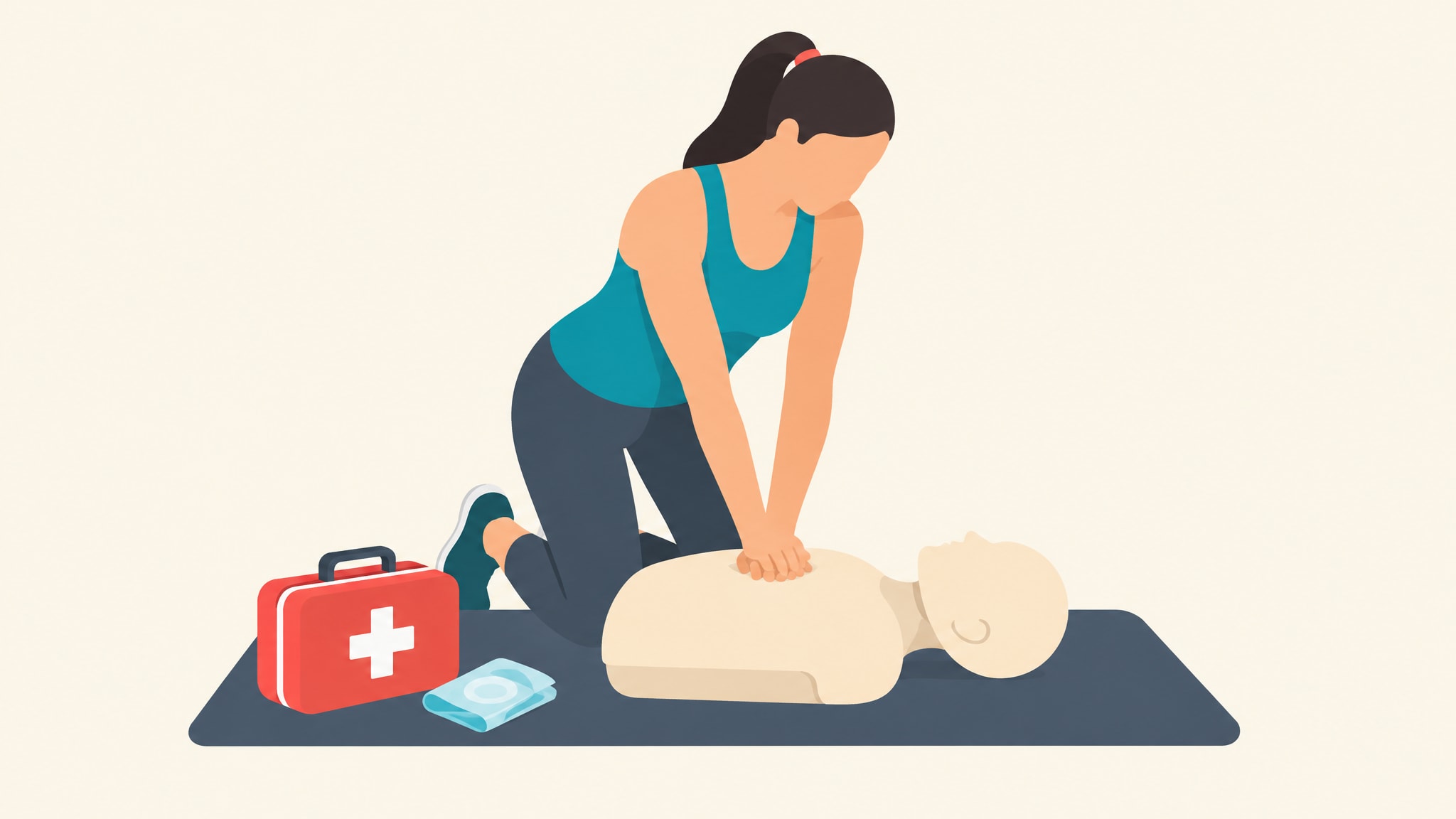
The training is practical and tied to situations a trainer meets at work. It covers spotting a collapse, starting CPR, using an AED, controlling bleeding, and handling the injuries and sudden illnesses that come up in training areas. Those include a client who goes down mid-set, a fall from a treadmill, a dropped weight plate, or a person who faints or becomes unwell during a session.
Published material on treating sudden cardiac arrest and the use of automated external defibrillators supports treating CPR and AED skills as time-critical for anyone who trains clients. For a general, plain-language definition of first aid, MedlinePlus publishes an entry.
The course makes a trainer a capable first responder. It does not make a trainer a medical professional, and it does not teach diagnosis or treatment beyond the care given until help arrives.
Check, Call, Care Before Help Arrives
The Red Cross frames first response as a Check, Call, Care sequence. It gives a trainer a fixed order of actions when a session stops being routine.
- Check the scene and the person. On a gym floor that means loose equipment, wet surfaces and other members nearby, then whether the person responds and is breathing.
- Call for help. The trainer phones 911 or directs a named person to do it, and sends someone to bring the AED.
- Care for the casualty. This step holds the hands-on skills: CPR, AED use, and controlling bleeding until paramedics take over.
Speed matters in this sequence. A Gulf Physio article on emergency response reports an 85% survival rate when first aid starts within 5 minutes, falling to 72% at 15 minutes and 60% at 20 minutes. It also reports an increase of up to 20% from immediate first aid. These figures come from a clinic article about emergency response in general, not from cardiac arrest data, and they should be read as a case for acting early rather than as a prediction for any one incident.
Renewal: Keeping First Aid and CPR Certificates Current
Renewal is a calendar task. A trainer who treats it as one rarely has a certificate lapse in the middle of a contract, while one who waits for a reminder from the gym often does.
Tracking Separate Expiry Dates
Standard first aid and CPR-C can carry different validity periods, and one date can hide the other. A trainer who remembers only the first aid date may find the CPR card expired months earlier, which can be enough to fail a gym audit or an insurance check.
The fix is simple: log both dates, with a reminder set well ahead of each. As of 2026, the current rules are set out in the guide on how long first aid certification stays valid in BC, which is the place to confirm the periods rather than relying on memory.
Recertifying Before a Certificate Lapses
Booking before the expiry date keeps the certificate continuous and leaves room to choose a class that suits the work schedule. Waiting until the last week narrows the options.
Trainers whose CPR card has already lapsed can read about same-day CPR recertification in Vancouver. Seats on any given day depend on the posted schedule, so the schedule is what to check, not an assumption.
First Aid for Gym Staff and Yoga Instructors in BC
Gym staff first aid training does not have to be arranged one person at a time. A gym or studio can book one block for several staff, which puts front-desk employees, trainers and floor supervisors in the same class on the same day. Managers pricing a team booking can start with the group rates for gym teams.
First aid for yoga instructors in BC follows the same logic as it does for trainers. Yoga and group fitness instructors check the studio's written requirements and their insurer's wording before enrolling, exactly as described in the first section. An instructor who teaches at more than one studio may find that each has its own standard, so each written policy needs a look.
Scheduling Your Course Around Client Hours
Trainers' hours vary: early-morning clients, a midday gap, evening blocks. The class date should be chosen against the trainer's own client calendar, not against a general idea of what weekdays look like. Posted class dates are the only reliable source for times, and a trainer should confirm them on the current schedule before moving any client sessions.
A trainer who clears a single day for the combined course usually has less disruption than one who tries to fit training around a full book of clients.
Choosing a Metro Vancouver Location
Courses run in Coquitlam, Vancouver, Burnaby, Richmond and Surrey. The right location is the one that fits where the trainer works or lives and when they can attend.
A trainer who works in one city and lives in another can pick whichever is easier to reach on the chosen date. Someone searching for a fitness instructor CPR course in Vancouver will find Vancouver on the list, and for those weighing the two largest options, there is a short guide on Surrey or Vancouver: which course location to choose.
Booking Your First Aid Course
Three checks come before the booking. The first is the provider. It should be WorkSafeBC-certified, and how to check a first aid training provider lists what to look for. The second is the course: it should match the gym's written standard. The third is the dates, which should fit around client hours.
Next, choose a city from Coquitlam, Vancouver, Burnaby, Richmond or Surrey, then pick a date from the current schedule and book a seat. Book the course that the gym's written standard names. If no standard is written, book standard first aid with CPR-C.
Frequently asked questions
Does BC require personal trainers to hold first aid certification?
No provincial licence requires it, because personal training is not a licensed occupation in BC. The requirement usually comes from the gym as employer, from an insurer, or from a certifying body. Trainers should ask the gym for its written standard before enrolling.
Is standard first aid with CPR-C enough to work in a gym?
It is enough when the gym's written standard asks for standard first aid and CPR. If the gym's first aid arrangements name a workplace attendant, the course to check is Occupational First Aid Level 1, which is the more extensive WorkSafeBC course.
Do first aid and CPR certificates expire on the same date?
Not necessarily. Standard first aid and CPR-C can carry different validity periods, so a trainer should log both dates and confirm the current rules in the validity guide for 2026.
Can yoga instructors take the same course as personal trainers?
Yes. Yoga and group fitness instructors run the same checks first: the studio's written requirements and the insurer's wording. Once those are confirmed, the same course options apply.
Which Metro Vancouver location should a trainer choose?
The one that fits where the trainer works or lives and when they can attend. Courses run in Coquitlam, Vancouver, Burnaby, Richmond and Surrey, and the posted schedule shows which dates are open in each city.
Need Safety Training?
Metro Safety Training runs WorkSafeBC-recognized first aid, CPR and workplace safety courses in Coquitlam, Surrey and Burnaby, and on-site anywhere in Metro Vancouver.
coquitlam
surrey